
OLAI – BUILDING NOW

Wearable Intelligence for overlooked brains. overlooked brain.

Because your experience deserves better tools.

Smooth metallic stone partially embedded in a textured slab of brown clay.

We’re starting with women because when you build for those most overlooked, you build something better for everyone.

Solid orange circle with a slightly darker orange ring inside it.
Serotonin fluctuates monthly
Solid orange circle with a slightly darker orange ring inside it.
Hormones alter neurotransmitters
Solid orange circle with a slightly darker orange ring inside it.
EEG patterns change weekly
Solid orange circle with a slightly darker orange ring inside it.
Neural networks in flux
Solid orange circle with a slightly darker orange ring inside it.
Dopamine sensitivity shifts
Solid orange circle with a slightly darker orange ring inside it.
Falling progesterone
Solid orange circle with a slightly darker orange ring inside it.
Low estrogen → brain fog
Solid orange circle with a slightly darker orange ring inside it.
Decades of research, zero tools
Solid orange circle with a slightly darker orange ring inside it.
Male-dominant datasets
Solid orange circle with a slightly darker orange ring inside it.
Cycle-blind algorithms
Solid orange circle with a slightly darker orange ring inside it.
Brain fog dismissed
Solid orange circle with a slightly darker orange ring inside it.
Emotional regulation cycles
Solid orange circle with a slightly darker orange ring inside it.
Real-time data missing
Solid orange circle with a slightly darker orange ring inside it.
One-size-fits-all tracking
Solid orange circle with a slightly darker orange ring inside it.
Built on incomplete data
Solid orange circle with a slightly darker orange ring inside it.
Olai exists to change that.

The result is a medical system built on an incomplete picture of human biology.

40%

Clinical Trial Representation

Women make up only 40% of clinical trial participants - despite comprising half the global population. The research baseline was never built forus.

Harvard Medical School, 2022

2x

Adverse Drug Reactions

Women experience adverse drug reactions at twice the rate of men across 76 of 86 drugs studied. This is what happens when dosing is calibrated to a body that isn't yours.

Nature, 2025

0

Wearables Built For This

Not one consumer wearable accounts for hormonal cycle phase or neurological diversity in its health algorithms. Every insight it gives you was designed for someone else.

Your brain. Your cycle.
Finally visible.

The research linking hormonal cycles to brain state has existed for decades.
What has never existed is a tool that translates that science into something visible, personal, and actionable in real time...

...until now.

3D low-poly model of a human brain with white surfaces and golden edges on a dark background.

Multimodal biomarkers across the neurophysiological systems that shape focus, emotion, and cognition.

Close-up visualization of 3D DNA double helix strands with dotted texture on a gray background.

Hormonal phase data mapped directly to your neural signals — context your brain has always had, now made visible.
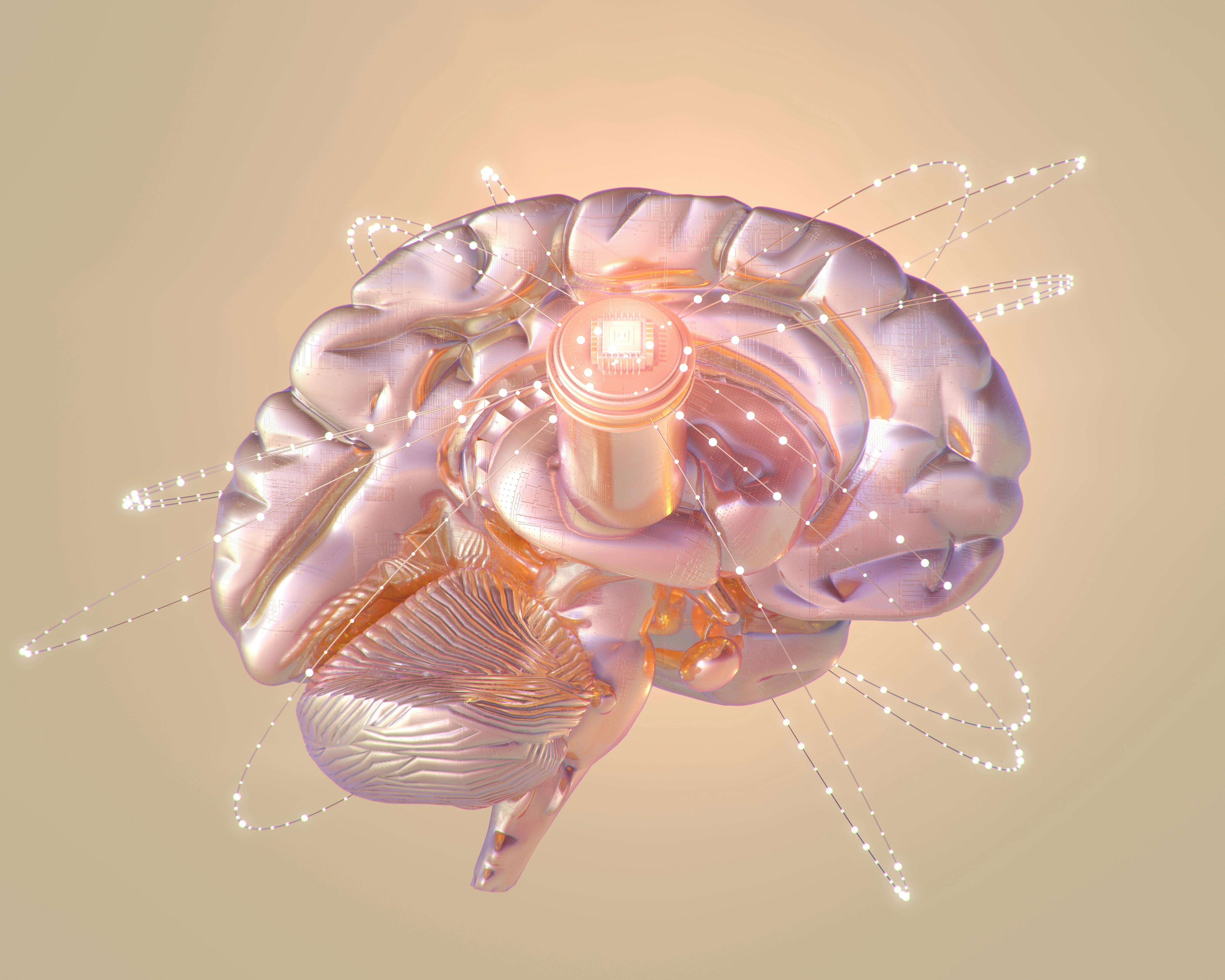
3D illustration of a human brain with a glowing microchip embedded in the center and orbiting digital connections around it.

Algorithms built for divergent neurotypes that reflect how neurodivergent brains interact with hormonal change over time.


The science

Decades of research show that hormonal cycles shape whole‑brain network dynamics, connectivity, and signal complexity across the month.

Neurodivergence in a cycling system

For people already managing conditions like ADHD and anxiety, these hormone‑linked brain shifts can amplify swings in focus, overwhelm, and emotional regulation from week to week.

Cognition and executive function

Estradiol around ovulation is associated with increased activation in hippocampal and prefrontal regions that support memory, planning, and complex problem‑solving.

Blurred image with dark and orange tones featuring vague circular shapes.

Most clinical studies, datasets, and algorithms still under‑represent women and rarely model menstrual phase, meaning many digital health tools are trained on male‑dominant or cycle‑blind data.

Blurred image with warm orange and brown tones transitioning to cooler gray and purple hues.

In the luteal phase, higher progesterone is linked to stronger fronto‑striatal and amygdala responses, altering emotional sensitivity, motivation, and stress and threat processing.

Black abstract icon resembling a stylized 'a' with a curved line and dot above it.

Where Olai comes in

Olai builds directly on this evidence base, translating hormone‑driven changes in brain state into real‑time, cycle‑aware support instead of one‑size‑fits‑all tracking.

A better future starts with being seen clearly.

Be among the first to access Olai at launch.

You're in. We'll be in touch soon.
Something went wrong. Try again.